

Smarter on the road every day
With 80 drivers, 35 vehicles and 65 routes per day, our transport department has grown into a full-fledged transport company in recent years. Logistics Manager Frank Crutzen is constantly optimising. He does so with smart loading, efficient routes and a fleet that suits the variety of customers. This way, we serve our customers tailored to their needs, with minimal impact on the environment.
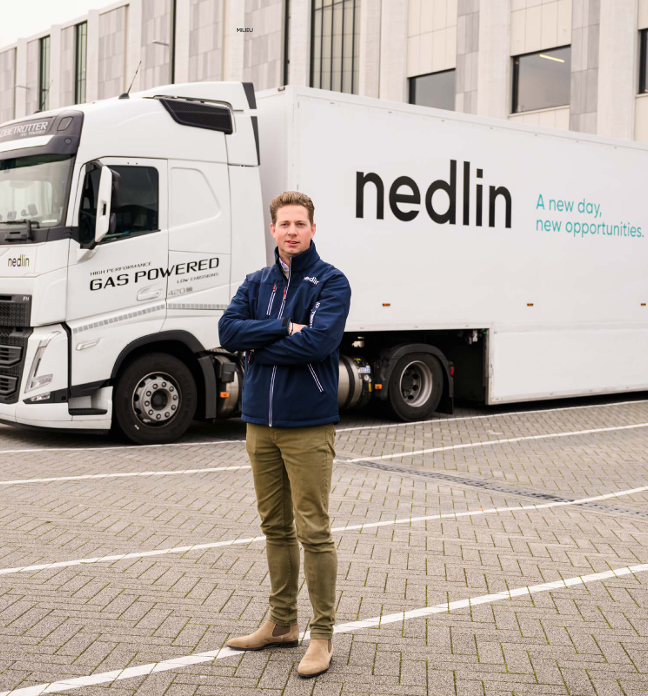
From Sprinter to LHV and double- decker, Nedlin’s fleet embraces a wide range of vehicles. These include tractor semi-trailers, box trucks, double-deckers and trailers. As a result, the type of truck can be accurately adapted to the cargo and customer conditions, Frank says. “This way, we achieve a degree of efficiency and sustainability that customers sometimes did not think possible. And by doing so, we also minimise the environmental impact.”
Moreover, new and existing routes are monitored on an ongoing basis. Could it be even smarter, and even more efficient? “We are constantly checking whether the vehicle type we deploy best suits the customer’s volume. And whether we can make useful combinations.” Supplying the Radboudumc in Nijmegen, for example, initially took place twice a day with a tractor-trailer. “We now drive there by double-decker once a day”, Frank says.
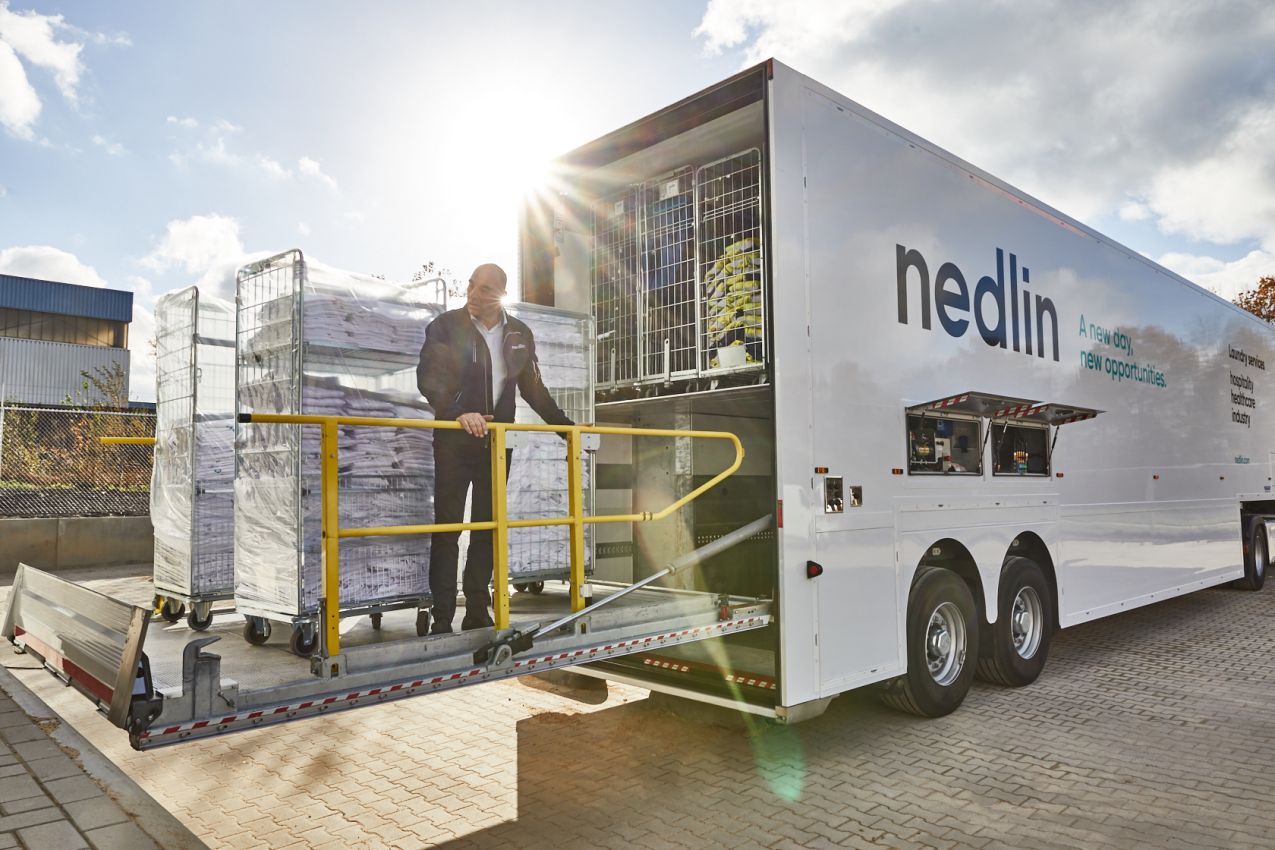
Together with builder Burgers, Nedlin had that double-decker customised to fit exactly two layers of containers. “With this customer, that means halving mileage and hours, and significantly reducing emissions.
Monitoring consumption
Automation plays an important role. “We have an awful lot of data at our disposal, collected by the vehicles’ black boxes. That has now been converted to two Power BI dashboards, so we can see where opportunities lie.” One of the dashboards focuses on consumption. “We see the impact of driving behaviour. We talk to drivers about that.” Drivers embrace fuel-efficient driving: “They turn it into a competition”. In addition, proper maintenance is crucial to reduce consumption and thus CO2 emissions: correct tyre pressure, for example, or proper alignment of truck and trailer. Every six months, the entire f leet gets a service. “That means two trucks are in maintenance every week. So we have to plan that well.”
More efficient driving
The second dashboard monitors efficiency: the course of the day, the load factor of trips and vehicles. “This allows us to properly manage things like route optimisation and loading on a daily basis, for example in case of fluctuations in demand. This way, we continue to improve services for our customers.” A planning tool helps to optimise planning. “We drive 24 hours per day, 7 days per week. Then, also for business continuity, it is important to safeguard processes properly. Moreover, the tool allows us to plan far ahead, allowing us to respond well to changes.” Drivers also know what to expect at an early stage: usually a week in advance, sometimes even a year.
The next step
Frank manages the drivers together with a fleet manager and a transport planner, two young colleagues who advanced from operational roles. “They have both driven for Nedlin as drivers, which is a huge advantage. They understand well what goes on within the group and easily connect with the drivers. That results in a strong team with good people.” The stability of the department offers room to take the next step. Because there are plenty of challenges for Frank to consider. Electric driving, for example, the logistics issue of our time. Until 2030, diesel trucks built in 2024 will still be allowed to enter zero-emission zones in cities. After that, only electric trucks will be welcome in city centres - in some cities, that is even the case today.
Electric driving
“That is a huge challenge that we need to take up with customers and other partners”, Frank says. “That is why we are already looking today at how we will deal with this in the coming years.” As a B Corp-certified company, Nedlin owes it to itself to lead the way, he believes. “We always look for opportunities that the market offers.” For instance, Frank has ongoing discussions with manufacturers about their current offerings and expectations for the coming years. He is also exploring options for optimal on-site charging infrastructure. “During 2026, we will deploy the first electric truck: that is our ambition. In the meantime, we are driving the most sustainable option available today, and our focus for long distances has been on the Volvo LNG truck for years.”
Passion for the craft
For those drivers, all this innovation is just great. For some, the truck is like a second home. “It’s nice to see how much passion they have for the craft.” Whenever something goes wrong, Frank and his colleagues’ door is always open. “You rarely see drivers, as they sit in their trucks all day. This makes it all the more important that they can always reach us. We are there for them: I think that feeling is very valuable.”
Commerce, Production, Logistics
This attitude also benefits the customer. “Some drivers walk across the Grand Place in Brussels with large containers every night. They love the variety. Other drivers prefer to drive to hospitals, where they contribute to healthcare. Either way: they all work at Nedlin because they want to add value. Our drivers close the triangle between commerce, production and logistics, making them very important ambassadors for our company. That makes their work so crucial.”
From B to CE driving licence
The drive for innovation and the wide f leet of vehicles also make the work interesting for drivers. “In recent years, several drivers have been trained in our Nedlin Drivers Academy from box truck to CE licence. You can start here with your B licence and be driving the largest vehicle 3 years later. So if you are ambitious and like driving a nice truck, you are in the right place at Nedlin.” As it should be, Frank thinks. “Retaining and engaging people is super important in this tight labour market. If you have a driver with ambitions, you want to keep them on board.” This is about more than just a fleet of vehicles and training; it is also about attention. “We involve drivers in new plans in advance and are true to our word. With us, they have a pleasant workplace with well-maintained vehicles. We offer people a stable future.”