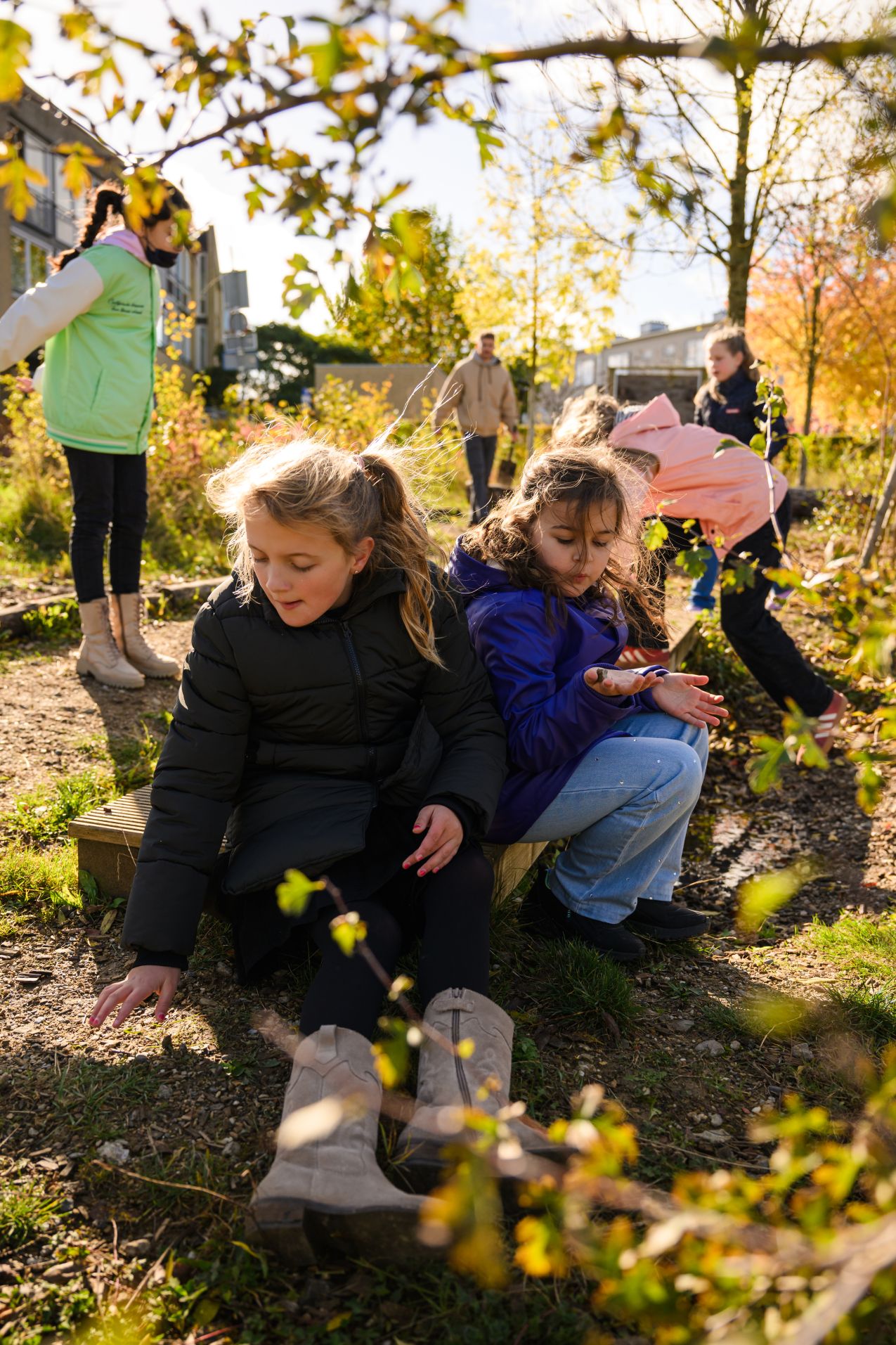
Outdoor lesson in the Tiny Forest
In 2026, Nedlin will plant its fifth Tiny Forest at a nearby primary school. Simon ‘De Moestuinman’ Eurlings is closely involved in the tiny forests. In planting as well as in the follow-up, when he works with students on maintenance and nature education. He does this with great success, because when De Moestuinman arrives at schools, students are eager to get outside. About creepie- crawlies, outdoor classes and infectious enthusiasm.
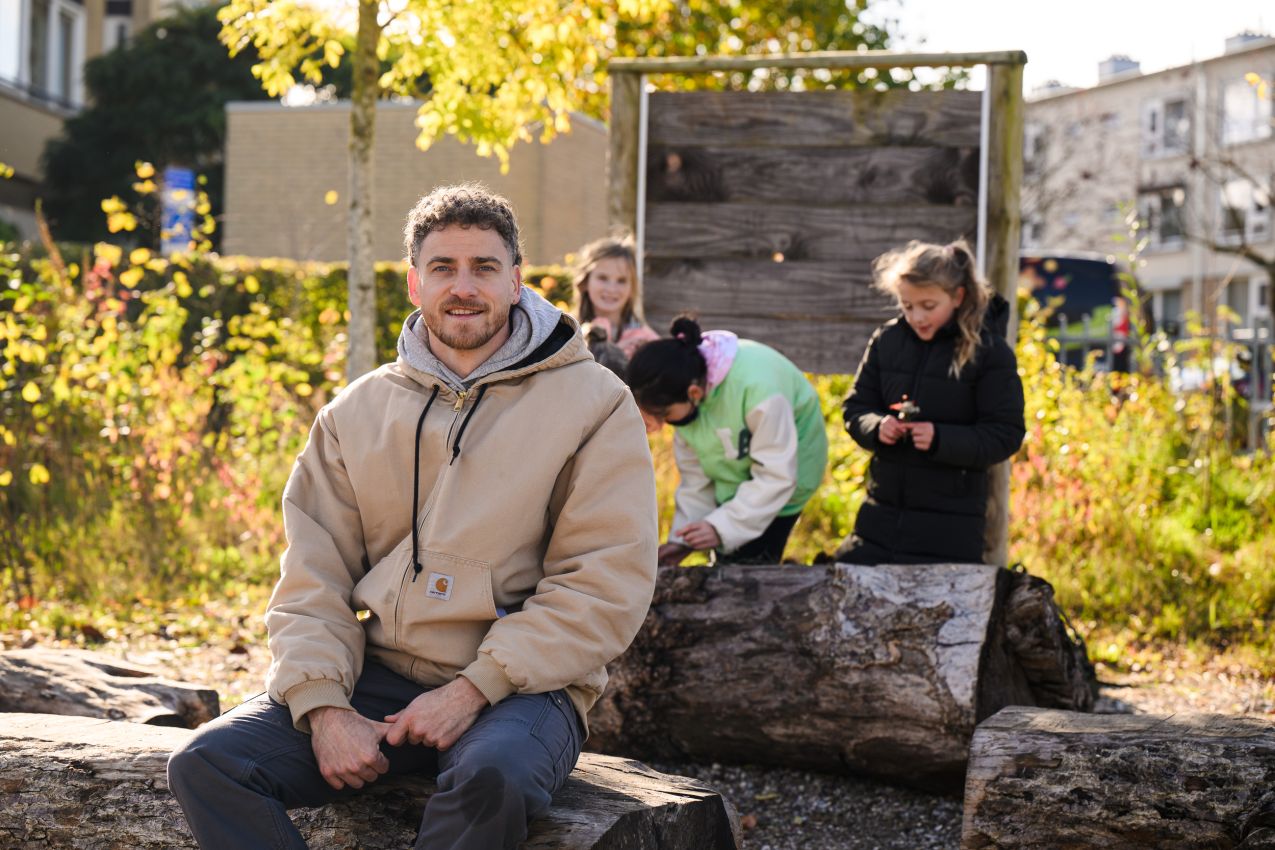
When I enter the classroom, the kids are extremely eager.
Simon ‘De Moestuinman’ Eurlings is slowly becoming a celebrity in South Limburg. On Instagram and TikTok, he brings his vegetable garden and all that grows and flourishes in it to the attention of young and old alike. That success began as a corona joke: a vegetable garden with videos on social media. Before Simon knew it, he was teaching in primary schools as De Moestuinman. Or rather: in the vegetable garden or in the Tiny Forest. Because Simon prefers to share his knowledge outside. Feet in the mud, hands in the clay, for everyone who wants to hear it.
CROCODILES
Besides teaching in primary schools, he wrote a children’s book on vegetable gardening, gives vegetable gardening workshops and lectures. “All to get people to embrace nature again, even if just a little bit.” Through his contacts at IVN Natuureducatie, he also came across Nedlin’s Tiny Forests. “Together with IVN, I am working on creating the small forests. Kids love them. They have lunch in the Tiny Forest and play hide-and seek. When there is water, they feed the imaginary crocodiles. That’s really nice to see. But how do you keep it alive throughout the school?” It is precisely the combination of nature and education that is the reason for Nedlin to support the project. The Tiny Forests are always located near a primary school, so children can grow up with nature and learn the importance of plants and animals. In total, Nedlin has thus already planted nearly 3,000 trees at primary schools in Hoensbroek, Elsloo, Vaals and Brunssum. A Tiny Forest in Valkenburg will follow in 2026. In order to provide that aftercare properly, Simon stays on after construction. Among other things, he teaches about the seasons and creepie-crawlies, which are “the greatest hit”. But the Tiny Forest also offers starting points for other subjects. “With little ones, it is often about wonder and experience. Using a bucket of water, we look for things that float or sink. Or we look for something that stings, which is red or yellow.” With the older children, he goes on a ruler safari. Or they make word garlands with things in the Tiny Forest, or mandalas from nature.
PLANTING SEEDS
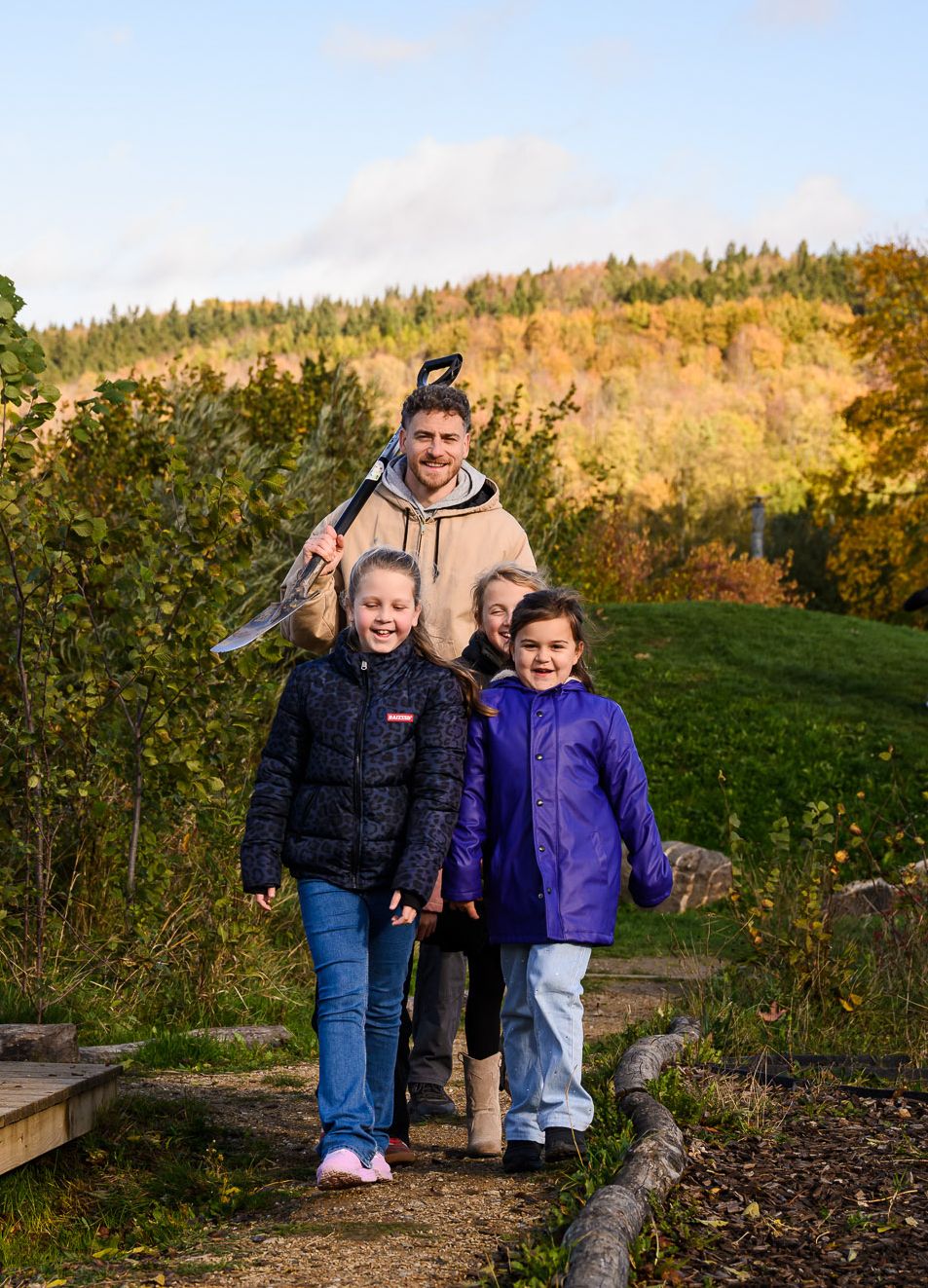
In doing so, Simon plants a seed with students and teachers alike. “There are lots of things to think about. It helps teachers to show what can be done. To take some time and look at things with a different perspective, apart from all the obligations schools have.” A group of pioneers can ensure that the outdoor class becomes embedded in the curriculum, so that teachers do something with it every month. For the students, those classes are a treat. “When I enter the classroom, the kids are extremely eager.” This is partly down to Simon himself, who knows how to convey his own wonderment to children with great enthusiasm. Moreover, there are fewer and fewer men in the teaching profession, so boys in particular like having a man in front of the class. Especially if they have seen him on TikTok.
OTHER CHOICES
But the biggest gain, in Simon’s opinion, is that the students spend time outdoors. “Of course, a Tiny Forest is also important for biodiversity and helps against heat stress. But for me, what matters most is having children experience nature. They planted the trees themselves, which they will always remember. It is their forest, so they want to take good care of it.” That carries on into the future, he thinks. “Children learn to respect nature. This will hopefully cause them to make different choices when they grow up.” Sometimes he hears that children have also planted seeds at home. Or that parents started a vegetable garden. “That, of course, is the greatest thing: that children take the outdoor class home and tell their mom or dad. Can’t those stones be taken out of the garden so that we make a Tiny Forest here too?” This is how awareness spreads. As it should. “I think we need nature a lot more than we want to believe ourselves sometimes”.
“Children have lunch in the Tiny Forest and play hide-and-seek. When there is water, they feed the imaginary crocodiles.