

The best quality in every way
Linen is an experience, especially in hospitality. Comfortable sheets that offer a good night’s sleep and a tidy appearance. Soft, radiant white towels: Christian Kleinpass and Simon Bartholomes of linen supplier Dibella know exactly what customers want. And what it takes to achieve that perfect quality. “There are many parameters that we have to take into account.”
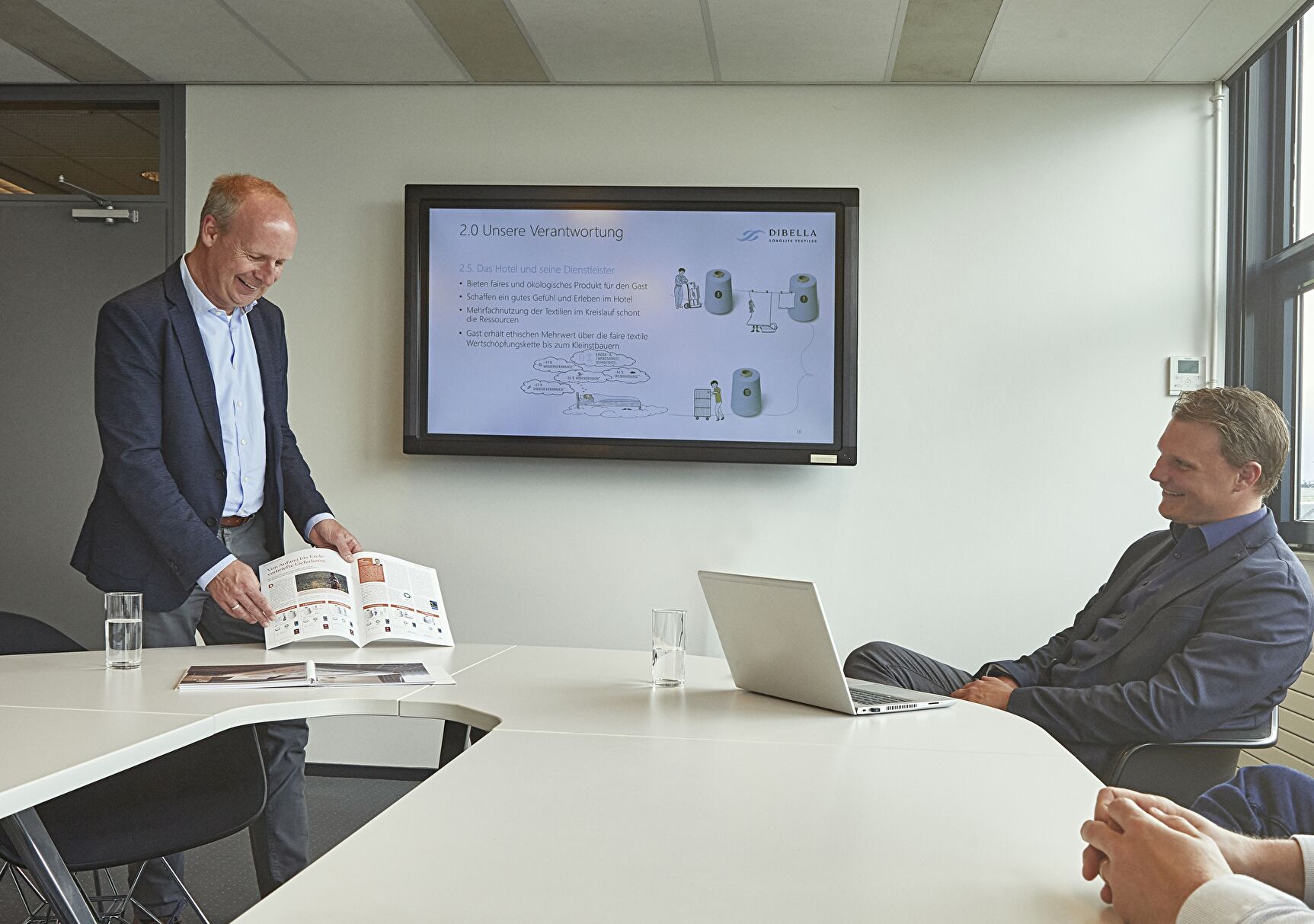
For more than 20 years, Nedlin has partnered with Dibella, which supplies linen for hotels, restaurants and healthcare institutions across Europe. Linen that meets all requirements, even if that sounds deceptively simple. Because the demands are high and the road to quality linen is full of challenges. From the customer side, from the laundry and with regard to the supply chain.
Kleinpass, Sales Manager Benelux and (partly) Germany, has been working at Dibella for 22 years. Over the years, he has seen the demands placed on linen change. “If you walked around the trade fair 20 years ago, you were actually comparing the prices per kg for terry cloth. There was hardly any difference between the cotton. But today, no two cottons are the same. Their qualities are now closely compared.”
New demands placed on linen
About 12 to 15 years ago, a shift started that is still ongoing. Sustainability is an increasingly important theme, in all its facets. The demand for stable quality is growing. Duvet covers and sheets are getting bigger and bigger, new designs are making their appearance. And due to continuous innovation, Nedlin's demands on textiles have also become stricter.
“In an industrial laundry process, forces are exerted on the textile that you would never be able to achieve at home.”
“There are many parameters that we have to take into account”, says Kleinpass. “In an industrial laundry process, forces are exerted on the textile that you would never be able to achieve at home.” Moreover, those forces are ever increasing. Flatwork ironers go faster than before, presses are more powerful. Nedlin hardly uses water and energy in the washing process - that also places different demands on the linen.
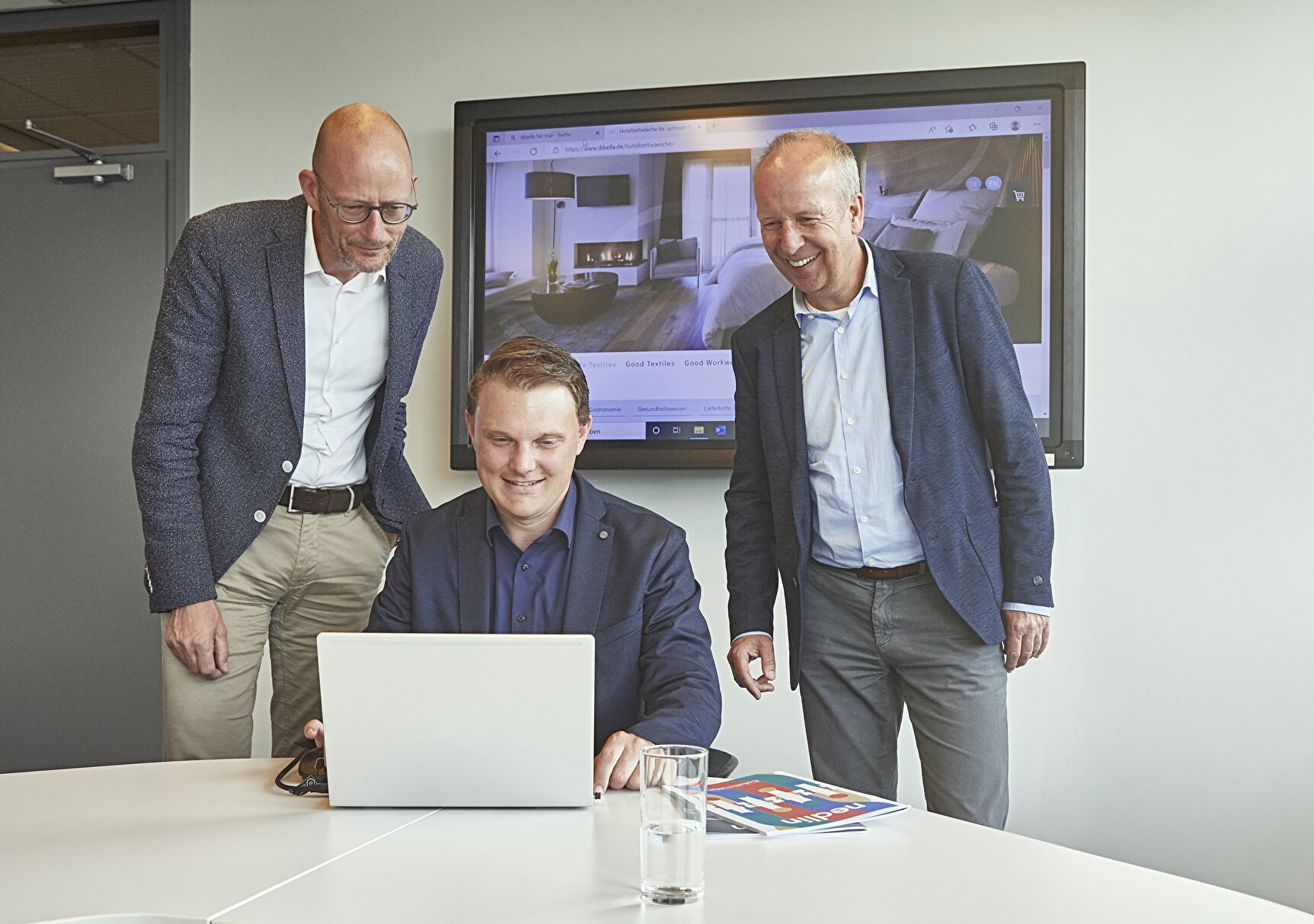
Plus size duvet covers are more sensitive on the ironers. This makes the quality of the fabric even more important, because only from straight fabrics can the employees in the workshop sew a straight sheet or duvet cover that slides through the ironer without any problems. Striped patterns give way to solid white - another challenge, because in solid white, every crease is visible. But the parameters to which Kleinpass refers extend even further.
Transparency of the chain
“Customers want to know where the linen comes from”, says Bartholomes, Head of Purchasing and Board Member at Dibella. “And big players in the hospitality market have no choice. With the new European supply chain legislation, it is their own responsibility to keep an eye on the supply chain.” And they cannot afford to make mistakes. “Today, everything is traceable. In a weaving mill, someone only has to take a picture of a towel with the label of such a hotel. If the conditions are not right, that is a big risk.”
If you want to be sure of the best quality, you have to talk to the real and full producers, and have complete control over your production line.
Throughout his career, Bartholomes has often visited India and Pakistan, two important cotton-producing countries. “If you want to be sure of the best quality, you have to talk to the real and full producers, and have complete control over your production line. This mainly means that you have to form a well-functioning team. The managers of the spinning mill, weaving mill, textile finishing, manufacturing and quality management all have to sit at the same table.”
You can't rely on middlemen or buying agents, he says. They often change production location, depending on where the linen is cheapest at that time, so that each container looks different. “I have been working at Dibella for 16 years now, the last 6 of which as Head of Purchasing. In those years I have seen good production locations, but also many bad ones. Paint factories where people stand barefoot in chemical puddles, factories with a large lock on the emergency exit door, miserably dilapidated employee housing or weaving mills where ancient machines are operated in cramped and dirty production halls. That experience taught me that you have to look for the right partners yourself.”
Bartholomes has a checklist with requirements that producers must meet. He walks through their premises, talks to the people, checks emergency exits and working conditions. Dibella prefers to work with vertical producers, who have all the important production steps in-house. Once those steps - such as spinning, weaving and bleaching - have been separated, there is no insight into how work is being done and there is no consistent quality.
Growing awareness
Awareness about sustainability in the chain is growing. However, it is sometimes difficult for customers to see the wood for the trees. Kleinpass: “Due to the high demand for sustainable linen, more and more labels are appearing. That makes it complex, because sometimes, these labels are just greenwashing. For example, it might say 'eco-friendly product' on a towel. But that means nothing! We have therefore designed a label guide to show customers what each label means with just a few keywords”.
Due to the high demand for sustainable linen, more and more labels are appearing. That makes it complex, because sometimes, these labels are just greenwashing.
Nedlin and Dibella work closely together for the best quality linen. The partners learn from each other: Nedlin learns about the possibilities of the linen and details in the chain, while Dibella learns about the technical developments in the laundry. Together, the specific demands on the Dutch, German and Belgian market are discussed, as are the ways to provide customers with the best possible quality linen that is sustainable, aesthetic and practical.
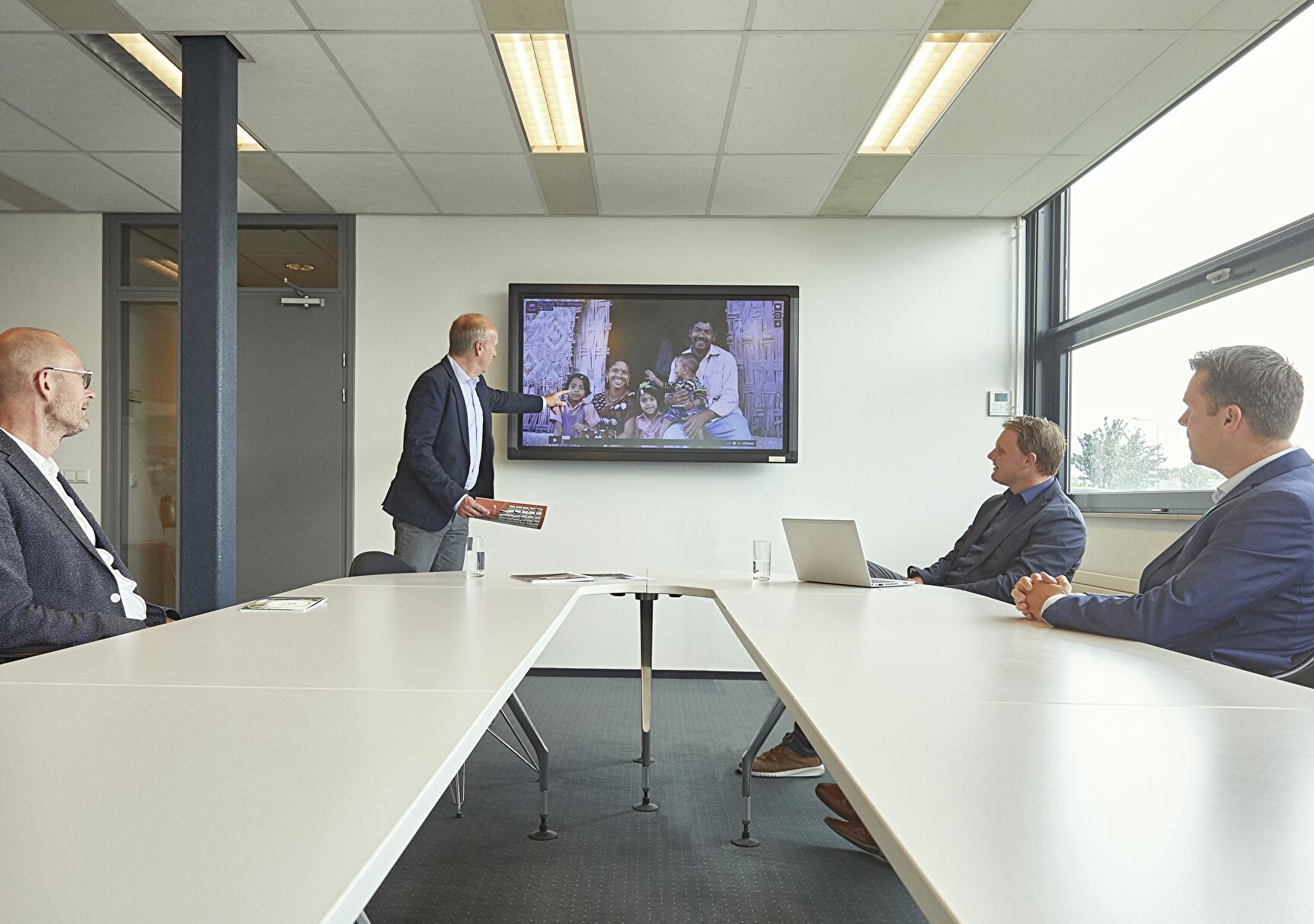
‘Made in Green’, the label that checks the sustainability of the weaving mill, the bleachery and the sewing workshop, is standard at Dibella for almost the entire range. Does the customer opt for organic cotton? Then the linen can even be traced back to the farmer. Dibella contributes to a healthy chain in a variety of ways. The linen supplier is a member of the Chetna Organic cotton cooperative, which finances, among other things, organic seeds for farmers. For example, they do not harvest sterile plants, as with conventional seeds, but cotton from which new seeds can be extracted.
Increasingly sustainable
The price for raw organic cotton is clearly higher than that of conventional cotton, partly because the demand is currently much greater than the supply. Bartholomes and Kleinpass see that more and more customers are willing to pay for sustainability. “Due to the crisis, the picture is now a bit distorted”, says Kleinpass, “but before the crisis, organic cotton was in demand more and more”. Bartholomes recognises this trend. “We now supply Made in Green even to our most price-sensitive customers.”
A new highlight in the collaboration is the establishment of the textile cooperative CIBUTEX for the recycling and upcycling of discarded textiles. Bartholomes: “We know the entire chain, so we have all options at hand. GOTS, Fairtrade – almost everything is possible. But what happens after the end of the textile’s life?”. Many textiles are recycled linearly, for example as cleaning cloths or insulation material in the automotive industry. But, says Bartholomes, “discarded textiles are a very interesting raw material for recycling”.
Together with Blycolin Textile Services, Edelweiss Groep and Lamme Textile Management, Nedlin and Dibella are therefore working on circular linen of the highest quality. The first - promising - trials have already been completed. Bartholomes: “It is already possible to make new textiles from old textiles, but not yet with the high standards we set for them. That is the current challenge. If we overcome that, then less oil will be needed for new polyester, and less new cotton. It would be great if that linen could eventually also be used in hospitality.”