

Logistics complete the cycle
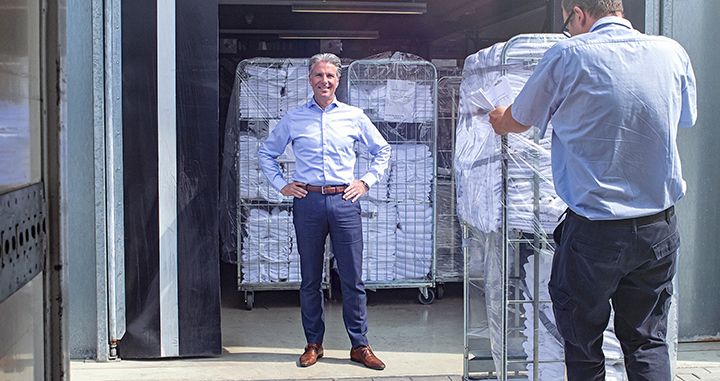
You might think that an industrial laundry facility is all about large washing machines, presses, dryers and ironing lanes. Of course these tools are essential, but the logistical operations around them are at least just as important. If the logistics are not running smoothly, the clean laundry will not get where it needs to go, explain Bjorn Frijns (Operational manager Hospitality) and Mark Zegers (logistical manager) of Nedlin.
“Our logistics of collection and delivery are the finishing touch and complete the production cycle. Within our company, drivers are also service providers. Along with our account managers, they are the face of our organisation for a lot of our clients”, says Frijns. “This means that our drivers have to comply with a lot of requirements. This is not always easy in a tight job market, but we are lucky enough to have a high-quality team.”
Stable under unpredictable circumstances
This team of 39 drivers is managed by Zegers, who needs to make sure that the laundry will arrive on time and in good condition, at 190 delivery points in the hospitality and healthcare sector. “Especially in the hospitality sector, we sometimes run into challenges. For example, within the same week there may be a difference in volume of thirty percent”, Zegers explains. “And we have to drive to our clients in Brussels more and more early in the night, because the trucks will otherwise get stuck in a morning rush hour that keeps starting earlier.”
Frijns agrees that you encounter surprises sometimes, but he says that you cannot let this hinder the clients. “We want to de-stress our clients, which means that it is up to us to get things done. Quiet service is a part of this, such as putting the containers in a straight line and turning off the lights when you leave.” According to both men, the drivers usually have an excellent relationship with clients. Zegers always shares the clients’ positive feedback with the team.
With the tracking system 'Mobicoach' our transportation is more efficient, and our CO2 emission is reduced.
Healthy competition with a tracking system
Aside from a representative role in the client contact, drivers are also expected to be experts at ‘the new way of driving’. Every Nedlin truck has been equipped with a so-called Mobicoach, a tracking system that is linked to the on-board computer, so that data can be reported back to the driver. “The system does not only track where the vehicle is at that moment, it also gives information about the fuel consumption and driving behaviour, such as braking, rolling out and using cruise control”, says Zegers. “All of this is reflected in a total score, and our objective is to stay above 8.5. This results in some healthy competition among our drivers.”
Efficient and sustainable
Since our company has started using Mobicoach, fuel savings between 10 and 15 percent have been realised. “With this tracking system, our transportation is more efficient, and our CO2 emission is reduced”, says Frijns.
With this in mind, Nedlin has recently added a new truck to their vehicle fleet, which largely consists of Euro 6 trucks. Since recently, a double-decker truck that can transport twice as many containers as a regular truck has been on the road for clients who need large volumes. According to Frijns, this is more sustainable than electric transportation, at least for the moment. “Eventually we will certainly start using electric trucks, but so far these are not suitable for the distances we have to cover. For now a double-decker is better, this saves a whole truck.”
In logistics at Nedlin, efficiency and sustainability go hand in hand. “For example, we don’t like to drive with half-empty trucks”, Frijns explains. “That is why we sometimes raise awareness among our clients. So in case of a lower hotel capacity, we might do transport three times instead of five times a week. We actively contribute ideas, so that we can think of smarter solutions together with our clients.”
Since recently, Nedlin has been using a double-decker truck for clients who need large volumes. With this double-decker, we can transport twice as much as with a regular trailer. This way we can save on costs, and also reduce CO2 emission.
Our double-decker drives to the Franciscus Gasthuis in Rotterdam, the IJsselland hospital in Capelle aan de IJssel and the Franciscus Vlietland in Schiedam. With 20-24 transports per day, 6 days a week, the double-decker is put to good use; efficient and better for the environment!